

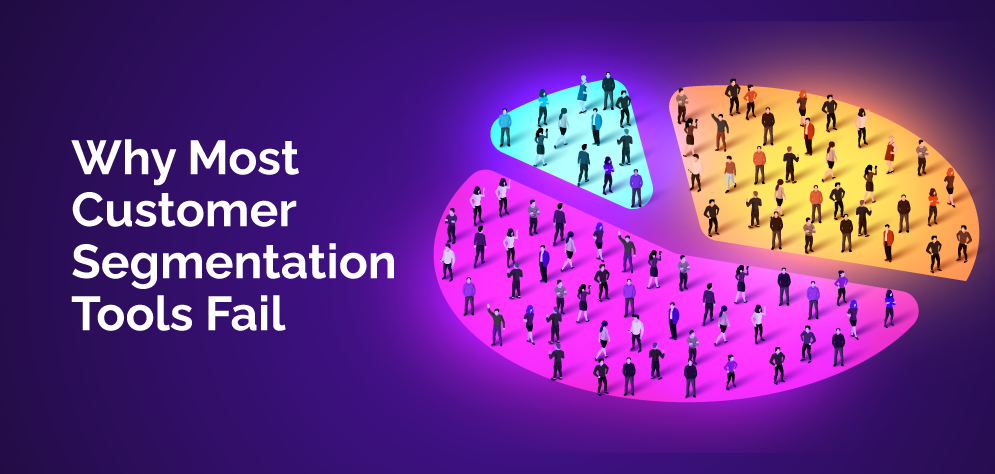

Your customer segmentation tools produce beautiful segments. Color-coded clusters. Clean demographic breakdowns. Presentation-ready charts that make your quarterly business reviews look impressive.
Your marketing results tell a different story. However, campaign response rates stay flat.
Retention numbers barely move. Customer lifetime value predictions miss by miles.
Here’s the uncomfortable truth: the tools aren’t the problem. The fundamental approach is broken. Most customer segmentation tools fail because they’re built on a faulty assumption: that demographic attributes predict customer behavior. They don’t.
The Demographic Segmentation Trap
Walk into most marketing departments, and you’ll find segmentation that looks roughly the same: age brackets, income levels, geographic regions, gender splits, purchase history grouped into neat categories.
These demographic segments feel logical. Moreover, they’re easy to explain to executives. Simple to build campaigns around. Comfortable because they match how businesses have always thought about customers.
There’s just one fatal flaw: demographic attributes don’t cause behavior. They correlate with some behaviors, sometimes, but correlation isn’t causation.
Consider two customers in your database right now. Both are 35-year-old women living in urban areas with household incomes above $80,000. Both made their first purchase six months ago. According to traditional customer segmentation tools, they belong in the same segment and should receive identical marketing treatment.
In reality, one customer has made eight purchases in six months, engages with every email, and refers friends. The other made one purchase, hasn’t opened an email since, and shows zero engagement signals. The lifetime value difference between these “identical” customers will be 10X or more.
This is the demographic segmentation trap. It produces segments that look clean but have almost no predictive power for the decisions that actually drive business results: who to target, what to offer, when to intervene, how much to invest.
In 2025, with the data and technology available through modern enterprise loyalty programs, continuing to segment by demographics is like navigating with a paper map when you have GPS in your pocket.
What Behavioral Segmentation Changes
Behavioral segmentation starts with a fundamentally different question. Not “who is this customer” but “what does this customer do.”
The signals that actually predict future behavior are behavioral: purchase frequency, recency of last interaction, category movement patterns, response to previous campaigns, engagement trajectory, channel preferences demonstrated through action.
These signals have something demographic attributes never will: they change based on the relationship between customer and brand. They provide feedback loops that enable learning and optimization.
Consider purchase frequency and recency: the foundational elements of RFM segmentation. A customer who purchased yesterday is fundamentally different from one who purchased six months ago, regardless of their age or income.
Furthermore, a customer loyalty platform built around behavioral segmentation tracks these signals in real time and adjusts segment membership dynamically. As customer behavior changes, their segment changes. As the relationship evolves, the treatment strategy evolves.
This creates segments based on engagement trajectories rather than static attributes. Some customers are growing: increasing purchase frequency, expanding into new categories. Others are stable: consistent patterns, predictable behavior. Still others are declining: frequency dropping, engagement fading.
These trajectories matter more than any demographic characteristic because they indicate where the relationship is headed, not where it’s been.
As a result, campaigns targeted using behavioral segmentation consistently see 3X higher response rates compared to customer segmentation tools using demographic targeting. That’s not a marginal improvement. That’s the difference between a campaign that pays for itself and one that drives material business growth.
Why Customer Segmentation Tools Fail at Behavior
If behavioral segmentation is so superior, why do most customer segmentation tools still focus on demographics?
The answer isn’t technology limitations. It’s a combination of data requirements, integration challenges, skill gaps, and organizational inertia.
Demographic segmentation works with batch data processed quarterly. Behavioral segmentation demands real-time data streams capturing customer actions as they happen across every touchpoint: website behavior, purchase transactions, email engagement, mobile app activity, customer service interactions, loyalty program participation.
Most companies have this data. But it lives in fragmented systems that don’t talk to each other. The ecommerce platform knows purchase behavior. The email system knows engagement. The CRM knows service interactions. None of these systems naturally share data in real time.
Building the data foundation for behavioral segmentation requires integration across systems. An enterprise loyalty program designed around behavioral intelligence handles this integration as core functionality, but bolting it onto legacy systems is genuinely difficult.
Then there’s the skill gap. Marketing analysts have been trained on demographic segmentation for decades. Shifting to behavioral thinking requires different skills: understanding statistical models that predict behavior, interpreting engagement signals, designing intervention strategies based on behavioral triggers.
Perhaps the deepest challenge is organizational inertia. “We’ve always segmented this way” is a powerful force. Changing segmentation strategy means changing how campaigns are planned, how budgets are allocated, how success is measured, how teams are organized.
Here’s the fundamental issue: you can have the best customer segmentation platform available, but if you’re using it to build demographic segments, you’ve bought an expensive tool to do the wrong thing efficiently.
From Segmentation Tools to Strategic Platforms
The best customer segmentation tools are worthless with the wrong approach. Behavioral segmentation isn’t a technology upgrade: it’s a philosophy shift about what drives customer decisions and how businesses should respond.
This shift matters more now than ever. Acquisition costs are 5 to 7X retention costs across most industries. Third-party data is disappearing. Privacy regulations restrict traditional targeting. The competitive advantage goes to companies that deeply understand their own customers’ behaviors rather than relying on broad demographic assumptions.
Starting this shift doesn’t require replacing your entire technology stack on day one. It starts with asking different questions:
What behavioral signals best predict customer lifetime value in our business? Which customers are on growth trajectories versus decline trajectories right now? What interventions have we proven actually change behavioral trajectories?
These questions can’t be answered with demographic data, no matter how sophisticated the customer segmentation platform processing it. They require behavioral data, behavioral thinking, and segmentation strategies built around behavior rather than attributes.
The companies winning at retention and lifetime value growth aren’t necessarily using more advanced tools. They’re using the right strategy: segmenting by what customers do, not who they are. Technology enables execution at scale, but strategy determines whether you’re executing on something that matters.
If your segmentation still starts with demographic attributes, you’re solving the wrong problem precisely. Better to solve the right problem imperfectly and improve from there.
Ready to build behavioral segmentation into your customer strategy? An enterprise loyalty program with AI-powered behavioral segmentation identifies customer trajectories in real time and triggers personalized interventions automatically. Learn more about the Valus Segmentation Engine.