

You spent three months building that email automation. The segmentation was thorough. The copy was sharp. The subject line had their first name right there in bold. You called it personalized customer engagement. Your customers called it noise.
Then you checked the numbers.
Open rate: down. Click rate: flat. Unsubscribes: climbing. And your highest-value customers, the ones spending 4x more than average, didn’t open a single message.
In fact, that gap between what you think you’re delivering and what they actually feel is silently bleeding your revenue dry.
The Lie You’ve Been Telling Yourself About Personalization
Let’s be honest about something nobody on your team wants to say in the Monday meeting.
That “personalized” campaign you launched last quarter? It went to 35,000 people. They all got the same offer. The only difference was “Dear Sarah” versus “Dear Ahmed.” That’s not personalization. That’s a mail merge with better fonts.
Research on consumer personalization expectations shows that 71% of consumers expect personalized interactions. And 76% get frustrated when brands fail to deliver. However, here’s the number that should keep you up at night.
A study on personalization perception gaps found that 85% of businesses believe they’re delivering personalized experiences. Only 60% of consumers agree.
Read that again. There’s a 25-point gap between your confidence and your customer’s reality. Your entire personalized customer engagement strategy is built on an assumption your customers don’t share.
In other words, you’re standing in a boardroom presenting “personalization ROI” while your best customers are already comparing your competitors’ apps on their phones.
You know that feeling? The CFO asks why the loyalty program that cost six figures has a 12% active rate. The CMO wants to know why engagement keeps dropping despite the “advanced segmentation” your team spent months building. And then you see the churn report and realize the customers leaving aren’t the bargain hunters. They’re the big spenders. The ones who used to love you.
That silence in the room when nobody has an answer? That’s the sound of personalization theater collapsing.

The numbers told the story. Nobody in the room wanted to hear it.
What Real Personalized Customer Engagement Looks Like (And Why Yours Doesn’t)
Fatima shops with you every two weeks. Average basket: 320 AED. Every Thursday evening, she browses new arrivals. In-store pickup is always her preference. Her SMS open rate is near perfect, but she hasn’t opened an email in four months.
Last month, however, she visited once. Spent 140 AED. She browsed your app twice, added items to cart both times, and abandoned both times. But your system didn’t notice. Nobody noticed.
Meanwhile, sixty days later, your automation triggered. “We miss you, Fatima! Here’s 10% off.”
She’d already been shopping at your competitor for five weeks. They noticed her behavioral shift in week one. Instead, they sent a relevant recommendation through SMS, her preferred channel, within 48 hours. She spent 1,200 AED with them last month.
That 10% off email you sent? She didn’t even open it.
As a result, this is the brutal difference between real personalized customer engagement and the illusion most brands are running. Real personalization doesn’t wait for a calendar trigger. It reads behavior in real time. The system knows which channel she prefers. It sees the frequency drop, the basket shrinkage, the cart abandonment pattern, and acts while the window is still open.
An enterprise loyalty program that reads behavior in real time and acts before the customer leaves turns invisible signals into revenue you would have lost. The signals are already there. But your current system just can’t see them.
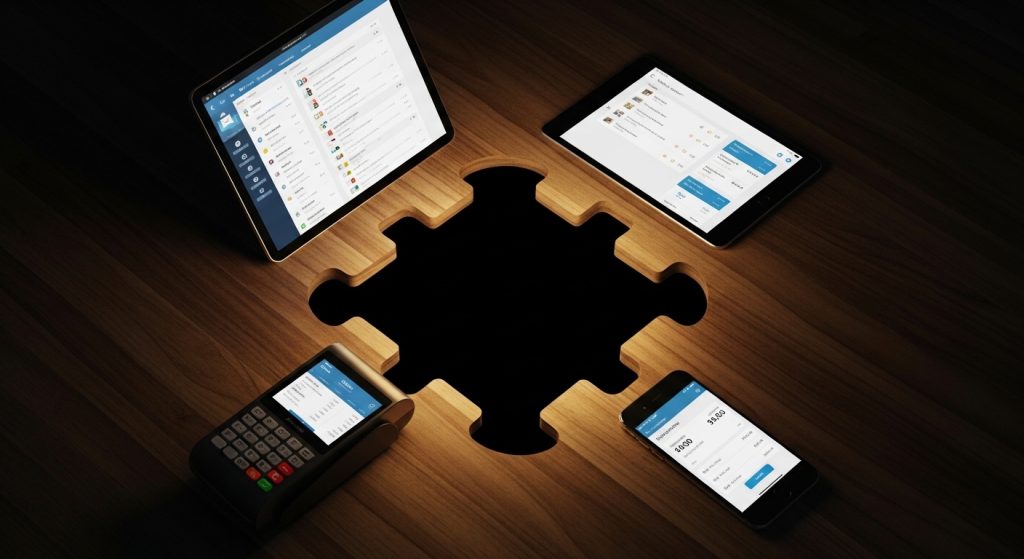
Four systems. One customer. Zero connection. That’s the blindness bleeding your revenue.
Why Personalized Customer Engagement Fails: The Data Foundation You’re Missing
Here’s what’s actually broken, and it’s not your marketing team.
The email platform has one version of Fatima. A different version lives in your POS. The app holds a third. And your loyalty program has a fourth. None of them talk to each other.
So when Fatima walks into your store after browsing your app, your sales team has no idea what she was looking at. Similarly, when she calls customer service after a bad delivery, the agent has no context. Consequently, when she finally gives up and leaves, your system thinks she’s still a “loyal member” because her points haven’t expired yet.
You don’t have a personalization problem. You have a blindness problem. And without solving it, no personalized customer engagement strategy in the world will save you.
What changes everything is a single, unified view of the customer. An enterprise loyalty program that connects every whisper, every click, every store visit, every abandoned cart into one living conversation. When combined with a customer loyalty platform that unifies every interaction into a single living profile, you stop guessing and start knowing.
Furthermore, customers will share their data when they trust the exchange. In fact, 69% of consumers appreciate personalization based on data they’ve shared directly. They want to be known. They just don’t want to be stalked. The difference is relevance without intrusion, and that requires architecture, not just ambition.
Stop Overthinking. Start Here.
A twelve-month roadmap isn’t necessary. Neither is boiling the ocean. Three things need to work properly, and they need to work now.
First: the behavioral drop-off trigger. The system that catches Fatima’s frequency change in week one, not month three. This alone can recover revenue you’re currently losing every single day without knowing it.
Second: channel intelligence. Knowing that Fatima ignores email but reads every SMS. Sending the right message through the wrong channel is the same as not sending it at all.
Third: post-purchase follow-up that isn’t a survey. Something relevant. Something that proves you were paying attention.
Business process automation tools replace the guesswork and manual segmentation draining your team, while ai automation services turn those signals into actions before the window closes. Instead of your team building 47 segments manually every month, the system identifies individual patterns and responds in real time.
Stop measuring open rates. Instead, start measuring repeat purchase frequency, basket size trends, and program engagement depth. The metrics that make dashboards pretty are not the metrics that make businesses profitable.
Your Competitors Already Started
True personalized customer engagement treats every customer as a person, not a row in a spreadsheet. It listens in real time. Responds in context. Acts before the moment is gone.
Consequently, the brands building this right now aren’t just improving their marketing metrics. They’re creating a level of customer intimacy that no ad budget, no discount code, and no flashy redesign can replicate.
Some of your competitors have already figured this out.
Not louder than you. Not spending more than you. Just seeing what you can’t.
The question isn’t whether your customers want personalized customer engagement. They do. The question is whether they’re getting it from you, or from someone else. One conversation could change how your customers feel about your brand.