


You changed the button color from blue to green. Rewrote the headline three times. Added a countdown timer. Tested a new hero banner. Ran fourteen A/B tests in six months. You did everything the “experts” told you would improve ecommerce conversion rate. Your numbers barely moved.
So then you checked the data again.
Traffic is up. Bounce rate looks acceptable. Products are competitive. But the conversion rate sits at 1.8%, exactly where it was a year ago.
In fact, here’s what nobody in the optimization meeting wants to admit: you’re testing variations of a broken foundation. And no amount of surface-level tweaking will fix what’s wrong underneath.
The Conversion Plateau Nobody Talks About
Every ecommerce team hits this wall eventually. The first round of optimizations delivers a bump. A better product image here, a cleaner CTA there. Conversion moves from 1.2% to 1.8% and the team celebrates.
Then it stops.
However, months go by. Tests keep running. Headlines get rewritten. Button colors change again. The numbers don’t move. Sometimes they actually get worse.
This is the conversion plateau, and it happens when you’ve exhausted what surface optimization can do to improve ecommerce conversion rate. You’re polishing the paint on a house with a cracked foundation. The problem isn’t the shade of blue on your checkout button. The problem is that your checkout takes 47 seconds, asks for 23 form fields, and doesn’t accept the payment method half your customers prefer.
You can’t A/B test your way out of that.
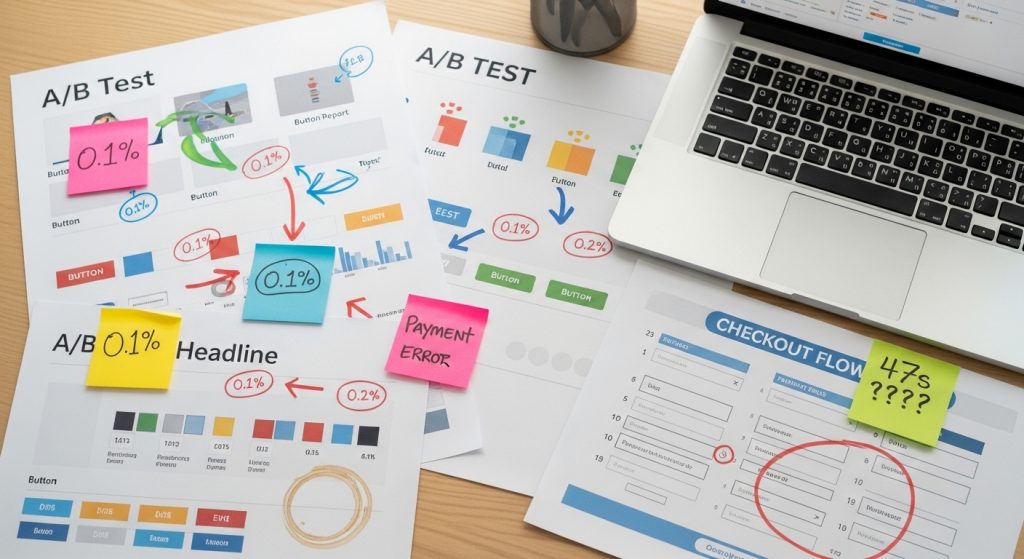
80% of the desk chasing 0.1% gains. The real problem sits crumpled in the corner.
The Silent Killers You’re Probably Ignoring to Improve Ecommerce Conversion Rate
Extensive research on checkout abandonment patterns reveals that 70% of online shopping carts are abandoned before checkout. That means for every 10 customers who want your product enough to add it to their cart, 7 walk away. The reasons aren’t mysterious. They’re structural.
48% leave because of unexpected costs at checkout. Not because the price was wrong, but because your checkout surprised them. Shipping fees, taxes, handling charges that appeared out of nowhere at the final step. That’s not a customer problem. That’s a trust problem.
18% abandon because the checkout process is too long or complicated. The average checkout flow has 23 form elements. Research shows the ideal is 12 to 14. In other words, most stores ask for nearly double the information they actually need, and every unnecessary field is a chance for the customer to leave.
Speed and Mobile: The Invisible Revenue Drain
Studies linking page speed to conversion performance show that sites loading in one second convert at 3x the rate of sites taking five seconds. Furthermore, a 0.1-second improvement in mobile speed lifts conversions by 8.4%. Your site probably takes four to six seconds on mobile right now. That delay isn’t just annoying your customers. It’s costing you revenue every single day.
And then there’s mobile. Over 70% of ecommerce traffic comes from mobile devices, but mobile conversion rates sit around 2.9% compared to desktop’s 4.8%. The gap exists because most mobile checkout experiences still feel like desktop pages squeezed onto a smaller screen. Tiny buttons. Awkward forms. Slow loading. Your customers aren’t abandoning because they lost interest. They’re abandoning because your mobile experience exhausted their patience. If you want to improve ecommerce conversion rate, this gap is where the biggest opportunity sits.
A Unified Commerce approach connects every touchpoint into a single buying experience, so speed, checkout, payment, and trust work together instead of fighting each other.
What Actually Works to Improve Ecommerce Conversion Rate
Stop testing button colors. Start fixing the foundation. Here’s what actually moves numbers.
Speed comes first because it has the highest ROI. Compressing images, reducing server response time, and eliminating unnecessary scripts can shave two to three seconds off your load time. That translates directly into conversions. No copywriting change, no design tweak, no promotional offer will outperform a faster site. Speed is the invisible conversion killer that most teams deprioritize because it feels technical rather than creative.
Checkout simplification is second. Cut your form fields to the minimum. Offer guest checkout prominently. Auto-detect city and state from postal code. Remove every step that doesn’t directly serve the transaction. Similarly, the research shows a potential 35% increase in conversion rate through better checkout design alone. That number is larger than most A/B test wins combined.
Payment flexibility is third. If your checkout doesn’t offer digital wallets, buy-now-pay-later, and local payment methods your GCC customers actually use, you’re losing sales at the finish line. 13% of shoppers abandon specifically because their preferred payment method isn’t available.
Consider a fashion retailer in Dubai. They ran months of A/B tests on product pages with no meaningful results. Consequently, when they shifted focus to foundations, the impact was immediate: reduced checkout fields from 19 to 9, added Apple Pay and Tabby, and cut mobile load time from 5.2 seconds to 2.1 seconds. Their conversion rate went from 1.6% to 3.4% in 90 days. No new traffic. Products unchanged. Prices untouched.

Nothing changed except the checkout. The store, the products, the prices: all identical. Conversion doubled.
Unified Commerce eliminates the disconnection between channels that causes friction, while conversion rate optimization tools give your team the visibility to act on real data instead of guessing which button color to test next.
Fix the Foundation Before You Test the Paint
Here’s a prioritization framework that will actually improve ecommerce conversion rate.
First: fix speed. This is the highest-ROI, lowest-effort change most stores can make. If your site takes more than three seconds to load on mobile, nothing else matters until this is solved.
Second: simplify checkout. Reduce form fields, enable guest checkout, and add the payment methods your specific audience uses. Test your own checkout on a phone. Time it. Count the taps. If it takes more than 60 seconds, your customers are feeling that frustration every single day.
Third: build trust signals. Clear return policies, visible security badges, and transparent pricing from the first page to the last. Trust isn’t a design element. It’s a conversion requirement.
Only after these three foundations are solid should you start A/B testing headlines, images, and CTAs. Otherwise, you’re optimizing the surface of something that’s broken underneath. A conversion rate optimization consultant can identify what’s broken in hours, not months, saving your team from another quarter of tests that go nowhere.
Your Competitors Already Fixed This
The brands that consistently improve ecommerce conversion rate aren’t the ones running the most A/B tests. They’re the ones who fixed their foundation first and tested on top of something solid.
Speed. Checkout. Payment. Trust. These four elements determine whether a customer who wants your product actually gets to buy it. Everything else is decoration.
Unified commerce solutions bring speed, checkout, payment, and trust under one roof so your team stops guessing and starts converting.
Your competitors are fixing their foundations right now. Not louder than you. Not spending more. Just converting what you’re leaving on the table. One conversation about your checkout flow could be the highest-ROI meeting you take this quarter.