

A CTO sits in a vendor demo, nodding along. The headless pitch sounds perfect: total flexibility, API-first architecture, build exactly what you want. Six months later, he’s explaining to the board why checkout crashed during the Ramadan sale. This is what happens when headless commerce development services don’t match your reality.
Headless commerce promises flexibility. It delivers complexity to brands that choose wrong.

If you’re evaluating headless commerce development services, the question isn’t whether headless is good. It’s whether your approach matches your reality. Here’s how to decide what actually fits your situation.
Headless Commerce Development Services: Promise vs Reality
The demo looked flawless. Contracts seemed reasonable. Timelines felt achievable. What nobody mentioned: you’re now the support team.
Headless architecture separates the presentation layer from commerce functionality. Your front-end talks to your back-end through APIs. Simple in theory.
McKinsey research shows that companies investing in modular, flexible technology architectures see faster time-to-market and better customer experiences. Headless enables exactly that kind of flexibility. However, here’s what vendors don’t emphasize: you now own everything you build.
That custom checkout flow? Your team maintains it. That personalized product recommendation engine? Your developers debug it when it breaks. That beautiful mobile experience? Your budget funds every update.
Brands with strong development teams, clear technical vision, and patience for 12-month implementation timelines win at headless. Companies investing in unified commerce architecture rather than isolated solutions see the best results. The ones who struggle? Brands that wanted flexibility but actually needed structure. Teams that chose headless because their competitor did. That was their first mistake.
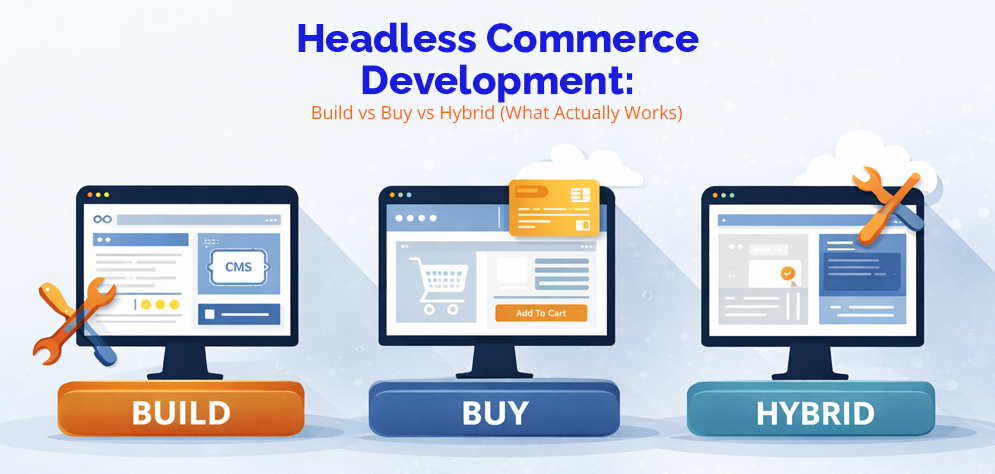
Build: When Custom Headless Development Makes Sense
Your phone buzzes at 2 AM. Checkout is down. Customers are abandoning carts. There’s no vendor to call, no support ticket to raise. You built it. You fix it.

This is the reality of custom headless commerce development services when you choose the build path. Specifically, building makes sense when your brand requires unique user experiences that no platform offers natively, your internal team has dedicated development resources with commerce expertise, and you have a 3-5 year technology vision, not just next quarter’s launch deadline.
Success requires dedicated development resources: minimum 3-5 engineers focused on commerce. You’ll need an ongoing maintenance budget, typically 20-30% of initial build cost annually. And clear ownership: someone accountable for uptime, security, and feature development.
Gartner analysis of enterprise commerce implementations shows solid headless builds require 6-12 months minimum. You promised the board a Q4 launch. It’s November. Your team is working weekends. Something has to give, and it’s usually stability.
Consider a luxury fashion brand that needed product visualization no platform supported. Their 18-month custom build created competitive advantage that justified the investment. They paired it with unified commerce solutions for back-end operations. Compare that to a mid-market retailer who built custom because they could, not because they needed to. Three years and $2M later, they rebuilt everything on a platform.
The build path rewards clarity. It punishes ambition without resources.
Buy: When Headless Commerce Platforms Win
Platform-based headless solutions serve different needs. Specifically, they fit when speed to market is your priority, your technical resources are limited or focused elsewhere, and you need proven infrastructure without building from scratch.
Commercetools offers enterprise-grade API-first commerce. BigCommerce provides headless capabilities with traditional platform stability. Emerging players like Fabric and Commerce Layer target specific use cases. For brands seeking unified commerce across channels, integrated platforms reduce complexity significantly.
As a result, the trade-off is straightforward: less customization, more structure. You gain speed and stability. You sacrifice the ability to build exactly what you imagined. And platform fees scale with your success. A solution that costs $50,000 annually at launch might cost $300,000 when you hit scale. Model your three-year total cost, not just year one.
A GCC grocery retailer learned this lesson the right way. They needed to handle Ramadan traffic spikes, multi-currency transactions across UAE and KSA, and regional payment gateway integrations. Building custom would have taken 14 months. They chose BigCommerce headless and launched in 4. The platform limitations they accepted mattered less than the market timing they captured. Their success came from pairing platform speed with unified commerce solutions that connected every touchpoint.

Ultimately, platforms win when speed and stability matter more than perfect customization.
Hybrid: The Middle Path for Headless Commerce
Hybrid approaches combine platform foundations with custom extensions. In fact, this is where unified commerce architecture truly shines.
Core commerce functionality runs on proven platforms. Custom front-ends or specific modules get built where differentiation matters. APIs connect everything into a cohesive unified commerce ecosystem. This approach fits brands needing flexibility in specific areas like checkout, personalization, or mobile experience, while requiring stability in others: inventory, order management, payments.
The architecture principle is simple: buy what’s commoditized (payment processing, basic inventory, tax calculation), build what differentiates (customer experience, unique workflows, brand-specific features), and connect thoughtfully by investing in middleware and integration architecture that enables true unified commerce.
A regional fashion brand needed rapid expansion across GCC markets. They were managing inventory across Dubai, Riyadh, and Jeddah warehouses. Stock syncing was a nightmare. Orders placed in UAE showed inventory from KSA. Customers received “out of stock” emails after checkout. They chose unified commerce solutions for operations while building custom front-ends for market-specific experiences. Platform stability handled complexity. Custom builds delivered differentiation. The result: seamless customer experience across 12 stores and 3 digital channels.
The hybrid path requires architectural discipline. Done well, it delivers flexibility without full ownership burden.
Headless Commerce Decision Framework
Before choosing your headless commerce development services approach, ask yourself the hard questions. Do you have 3+ dedicated commerce developers? Can you maintain what you build for 5+ years? Is commerce technology your competitive advantage or operational necessity? Do you need market presence in under 6 months, or can you wait 12-18 months for custom build? Have you modeled 3-year total cost of ownership?
Moreover, watch for red flags. Build fails without a dedicated team, with unclear requirements, or a “we’ll figure it out” timeline. Buy struggles when unique requirements can’t be served by platforms, when cost sensitivity hits at scale, or integration complexity overwhelms. Hybrid breaks down without integration expertise, with unclear boundaries between build and buy, or underestimated middleware needs.
Ultimately, regardless of build, buy, or hybrid, brands succeeding today prioritize unified commerce solutions that connect inventory, orders, and customer data across every channel. Architecture matters less than integration.
Choosing the Right Headless Commerce Development Services
Headless commerce development services aren’t right or wrong. They’re right or wrong for you.
The brands succeeding with headless commerce development services aren’t following trends. They’re matching architecture to capability. They chose build because they had resources. Platforms made sense when they needed speed. Hybrid worked because their requirements demanded both.
What separates winners from strugglers? Unified commerce thinking. The architecture decision matters, but connecting every touchpoint into seamless customer experience matters more.
Start with honest capability assessment. Model real costs. Define what differentiation actually means for your customers. Finally, choose the approach that serves your reality, not your aspiration.
Still unsure whether to build, buy, or go hybrid? Let’s figure it out together before you commit to something you’ll regret.