
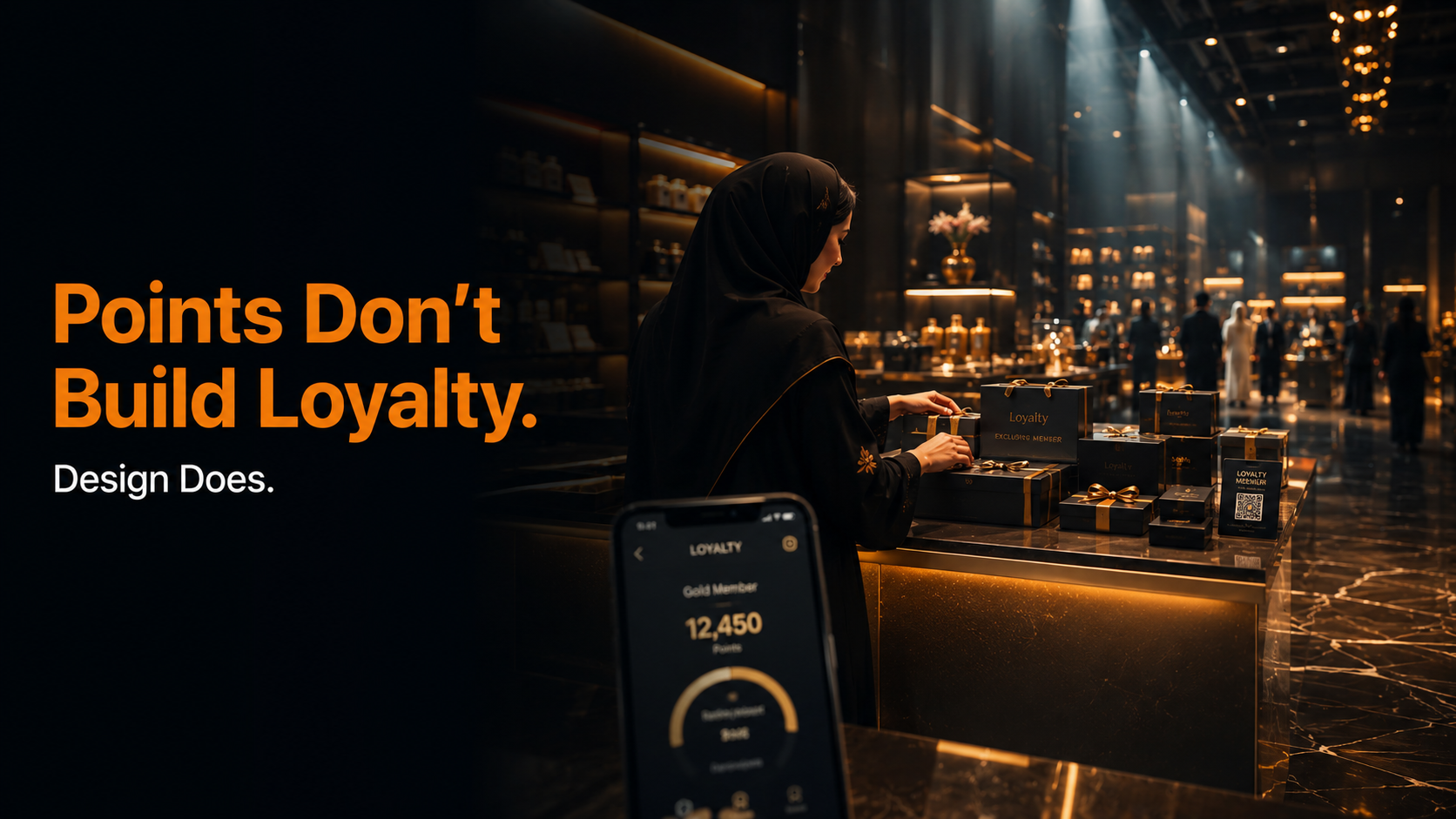

Most retailers measure loyalty program success by enrollment numbers. That is the wrong metric. A loyalty program design that enrolls thousands but fails to change behavior is not a program. It is a database with a points balance nobody redeems.
Hana manages loyalty for a mid-sized fashion retailer across four GCC markets. The program had 180,000 enrolled members. Her CFO was proud of that number. Redemption rate sat at 22%. Active member ratio was under 30%. On paper, the program looked healthy. In practice, it was hemorrhaging customers who felt nothing when they engaged with it.
The problem was not effort. Hana’s team worked hard. Nobody had ever audited the loyalty program design against what members actually experienced. Consequently, the program was not building retention. It was quietly accelerating churn.
Independent loyalty benchmarking data shows that 45% of loyalty accounts are inactive and 26.2% of points go unspent annually, representing billions in unrealized value sitting dormant across retail programs globally. If your numbers look anything like that, at least one of these five signs is already present in your data. Each one points to a loyalty program design failure you can fix once you correctly identify it.
Sign 1: Your Loyalty Program Design Has a Declining Redemption Rate
Redemption rate is the clearest signal of loyalty program design health. When members earn points but do not redeem them, the program has broken the value loop that makes loyalty work.
Healthy programs see redemption rates above 60%. Below 40%, the loyalty program design is in crisis. Below 25%, members have walked away in practice even if they remain technically enrolled.
Three design failures produce low redemption. First, the redemption process is too complicated. Members cannot find where to redeem. The digital experience buries the process in menus. In several GCC markets, retailers still require customers to visit a customer service desk in-store to redeem digital points. That friction kills the behavior before it starts. Second, the reward value is too weak. Marginal discounts on categories members rarely buy do not motivate action. Third, earning is too slow. When it takes 60 or more transactions to reach a meaningful reward, members lose interest well before they get there.
The fix starts with mapping the redemption funnel. Specifically, identify how many enrolled members have completed at least one redemption, and at which step the drop-off occurs. Once the friction point is visible, the loyalty program design fix becomes straightforward.
Sign 2: Program Fatigue Is Shrinking Your Active Member Base
Program fatigue happens when members stop engaging because the experience feels irrelevant, overwhelming, or generic. It shows up as declining month-over-month active member counts, email open rates dropping below 25%, and app usage falling three or more months after launch.
The root cause is almost always poor segmentation. When a loyalty program design sends the same offer to all members regardless of behavior, category preference, or purchase frequency, it misses the mark for most of them. A high-frequency buyer does not need a discount to visit. She needs a reason to increase her basket. A lapsed member does not need a newsletter. She needs a targeted trigger that makes her feel seen.
Many GCC loyalty programs still operate on broadcast messaging logic. “20% off everything, this weekend, everyone.” Members see that noise and disengage. Indeed, the programs with the strongest active member ratios are those that treat behavioral segmentation as a core loyalty program design requirement, not a future enhancement.
The fix is to implement at least five to seven distinct behavioral segments based on purchase frequency, basket size, and category affinity. If your current enterprise loyalty program infrastructure cannot support that level of segmentation, that is a design constraint worth addressing urgently.
Sign 3: Data Silos Are Undermining True Personalization
This is the most systemic failure in GCC retail loyalty. POS data sits in one system. E-commerce data sits in another. Mobile app behavior lives in a third. The loyalty platform cannot see a unified customer because nobody ever connected the data.
When data is siloed, the consequences are concrete. A customer who bought online last week gets an offer for a product she already purchased. A high-value customer who spent 40,000 SAR across three store locations gets treated identically to a first-time visitor. A customer who prefers WhatsApp communication keeps receiving email campaigns that she never opens.
The result is a loyalty program design that feels out of touch. It does not recognize loyal customers. Real behavior goes undetected. A 500 SAR customer and a 50,000 SAR customer look identical because the system cannot tell them apart.
Furthermore, without unified data, real-time personalization is architecturally impossible regardless of how sophisticated the campaign logic is. Retailers using a unified customer loyalty platform that integrates POS, e-commerce, and mobile data into a single customer view report measurably higher engagement rates and stronger redemption behavior across all segments.
How Does Loyalty Program Design Affect Customer Retention?
Loyalty program design directly determines whether a program builds retention or accelerates churn. A well-designed program creates behavioral loops: members earn, redeem, feel recognized, and return. A poorly designed program enrolls members, fails to engage them, and trains them to ignore all future communications. Consumer loyalty research confirms that 72% of consumers say loyalty programs make them more likely to spend with their preferred brand, while 56% actively increase their spending because of the program. Those numbers only hold when the underlying loyalty program design is built around engagement, not enrollment.
Sign 4: Missing Real-Time Triggers in Your Loyalty Program Design
The best loyalty program design operates in real-time. It recognizes a lapsed customer before she leaves. The next best offer surfaces at the moment of highest relevance. Behavior is met with an immediate response rather than a delayed one.
Most GCC loyalty programs are still batch-based. A weekly email blast to members who did not shop last week goes out on Monday. By then, the customer may have already purchased from a competitor on Saturday night. That response lag is not a timing problem. It is a loyalty program design problem.
Missing real-time triggers produces specific, measurable losses. A customer visits a store and buys from the same category she purchased six months ago, but no complementary offer fires because the system does not know she is there. A high-value customer abandons her cart, but no real-time incentive is triggered because the system runs on a 24-hour batch cycle. Additionally, a customer approaches a VIP tier threshold but is never notified because the tier tracking runs monthly.
Retailers with mature loyalty program design integrate real-time event streams from both POS and e-commerce systems. When an event occurs, whether it is a purchase, a cart abandonment, or a store visit, the system evaluates rules and determines whether to trigger a response immediately. The difference between a real-time customer loyalty platform and a batch-based system is not a technical detail. It is the difference between a program that feels intelligent and one that feels accidental.
Sign 5: Your Loyalty Program Design Has No Emotional Layer
The most overlooked failure in loyalty program design is the absence of emotional resonance. Transactional programs built entirely around earn-and-redeem mechanics are, by design, commoditized. There is no reason to stay loyal when the next competitor offers the same discount.
Modern consumers in high-income GCC markets want more than points. They want recognition, community, and purpose. Specifically, four emotional design elements separate programs that retain customers from those that merely delay their departure.
Recognition is the first element. VIP members visibly see their status and receive treatment that reflects it. Priority service, exclusive access, and surprise bonuses all signal that the brand knows who its best customers are. The feeling of being known matters disproportionately to high-value customers.
Community is the second element. A strong loyalty program design creates a genuine sense of belonging. Early access to new products, member-only events, and exclusive experiences that non-members cannot access build attachment that a discount cannot replicate.
Purpose alignment is the third element. The program reflects values the customer cares about: sustainability rewards, charitable giving options, and community involvement. GCC consumers are increasingly signaling that this dimension matters in their loyalty decisions.
Delight is the fourth and final element. The program occasionally surprises members with unexpected benefits. A birthday bonus they did not ask for. A surprise gift after a milestone purchase. These moments create emotional memory that strengthens retention in ways no points calculation can match.
Programs that skip the emotional layer are not loyalty programs. They are coupon clubs with enrollment forms. Moreover, retailers using AI-powered loyalty program design to personalize these emotional touchpoints at scale report significantly stronger member advocacy and higher customer lifetime value than those relying on static tier structures alone.
What Winning Loyalty Program Design Looks Like in GCC Retail
The GCC retailers with the strongest loyalty program design share a consistent set of choices. They have unified customer data from all channels feeding a single member profile. Real-time engagement engines with behavioral triggers replace batch campaigns. Member segmentation is tight, with tailored offers for each group. VIP recognition comes with exclusive benefits that feel genuinely differentiated. In addition, they test and optimize continuously rather than treating the program as a set-and-forget investment.
Furthermore, the best loyalty program design is integrated with fulfillment and omnichannel commerce so that loyal behavior is recognized and rewarded regardless of where the transaction happens. A customer who buys in-store should receive the same recognition as one who buys online. Anything less is a data silo problem dressed up as a loyalty problem.
Hana’s second version of her loyalty program design looked almost identical on paper to the first. Same technology. Same budget. Different design. She segmented her members into six behavioral groups. POS and e-commerce data were connected into one view. The redemption flow was rebuilt to require two taps instead of eight. A VIP tier with genuinely exclusive access was added on top.
Within two quarters, her active member ratio climbed from 28% to 51%.
The program did not change. The loyalty program design did.
Conclusion
Loyalty program design is where most retail loyalty investment either compounds or evaporates. Enrollment numbers are vanity metrics. Redemption rates, active member ratios, real-time engagement capability, and emotional resonance are the metrics that separate programs that drive revenue from programs that generate impressive slide decks and invisible churn.
Ultimately, if any of the five signs in this blog are visible in your current program, the gap is not impossible to close. It requires honest diagnosis, deliberate redesign, and the right platform to execute at scale. Start with an audit of your loyalty program design and work from the data outward.