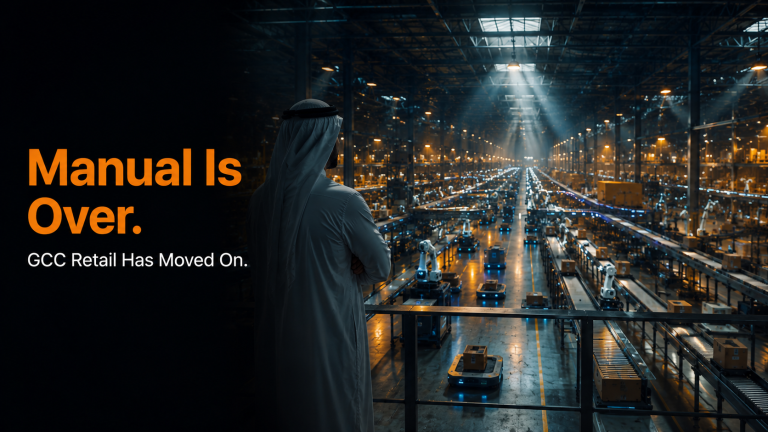


The GCC retail market in 2026 is not the same market it was three years ago. Labor costs are climbing. Consumer expectations are accelerating. Government directives across Saudi Arabia and the UAE are placing unprecedented pressure on retailers to digitize their core processes. Operations automation has moved from a strategic option to a business imperative. The mid-market retailers still running on manual inventory checks, spreadsheet pricing, and reactive fulfillment are not just falling behind. They are becoming ineligible for the next wave of growth.
This shift is not driven by hype. It is anchored in measurable pressure points, concrete financial drivers, and a regional regulatory environment that is changing the rules of what compliant looks like.
The Labor Cost Reality Behind Operations Automation
Karim runs a distribution center outside Riyadh. Two years ago, his operation relied on 60 manual checkers and sorters. His monthly labor bill was manageable. Saudization changed that calculation entirely.
Saudi Arabia’s localization mandate requires retailers to hire citizens at wages that typically run 40-60% higher than the expatriate labor markets that dominated a decade ago. The UAE faces similar upward wage pressure as it builds a more sustainable employment model. For Karim, that translated to annual labor costs exceeding 2.8M SAR for the same output.
Operations automation in inventory verification, stock reconciliation, and order picking reduced his headcount requirement by 38%. Moreover, accuracy improved from 94% to 99.7%. The payback period on his automation investment: 21 months.
Furthermore, beyond labor, the efficiency case is equally compelling. When operations teams spend 40% of their time on data entry and reconciliation rather than exception handling and optimization, margin leaks at every touchpoint. Automation closes that leak systematically.
Saudi Vision 2030: The Regulatory Case for Automation
Vision 2030 is not a vision statement. It is a directive with teeth. Retailers operating in KSA increasingly face digital transformation KPIs embedded in licensing requirements, B2B payment terms, and supply chain compliance demands. The expectation is structural, not aspirational.
Three specific mandates are accelerating the shift.
Digital Supply Chain Compliance
Retailers must demonstrate real-time visibility into inventory movement across distribution and retail networks. Manual reconciliation no longer meets regulatory expectations at the enterprise level.
Data Monetization Requirements
Vision 2030 explicitly pushes retailers to capture and leverage first-party data. Consistent data capture at every operational touchpoint is only possible at scale through automation. Retailers using retail analytics platforms to connect operational data to demand intelligence are already building this foundation.
Workforce Optimization Targets
Saudization targets explicitly favor organizations investing in productivity enhancement. Automation is the most direct path to qualifying. Indeed, the retailers who have automated core operations are positioning themselves as compliant, future-ready operators. Those still relying on manual processes are increasingly viewed as laggards in regulatory conversations.
UAE Retail Automation: Leading the Regional Curve
The UAE tells a different story. Here, the driver is competitive intensity rather than regulation. The UAE retail market is hyper-competitive, with major international operators and aggressive local players constantly raising the innovation baseline.
UAE retailers are leading regional adoption of automated replenishment systems that reduce stockouts from 8% to 2%, dynamic pricing engines that optimize margins in real-time, fulfillment center robotics, and omnichannel order orchestration. Retailers using unified commerce infrastructure to connect these layers report significantly lower operational error rates and faster order-to-delivery cycles.
The UAE market shows a two to three-year lead over Saudi and other GCC markets in automation maturity. Smart retailers in KSA and Qatar are studying the UAE playbook and implementing parallel solutions before the competitive gap widens further.
What Does Operations Automation Actually Deliver?
Specifically, five use cases are driving measurable impact across GCC retail right now.
Automated Inventory Verification and Cycle Counting
Manual cycle counting is the industry’s most expensive hidden cost. It is time-consuming, error-prone, and pulls inventory staff away from higher-value tasks. Automated systems using barcode scanning, RFID, and image recognition reduce cycle count time by 60-70%. In addition, discrepancy rates fall from 3-5% to 0.5-1%.
GCC retailers report inventory write-offs dropping by 0.4-0.6% of revenue within year one. For a 500M SAR retailer, that is 2-3M SAR recovered annually from a single automation layer.
Dynamic and Automated Pricing
Markdown optimization is where most retailers quietly lose margin. Manual pricing decisions based on spreadsheets and gut feel cost a typical mid-market retailer 2-3% in gross margin annually. That number is avoidable.
Automated pricing engines analyze demand elasticity, competitor positioning, inventory age, and margin targets in real-time. As a result, markdown optimization improves gross margin by 1.1-1.8%, and stockout rates fall because pricing is right-sized for demand.
Fulfillment Center Automation and Pick Optimization
Labor represents 45-55% of fulfillment center operating expense. Automation through wave picking, autonomous mobile robots, or sortation conveyors reduces picking labor by 30-45% while improving order accuracy from 96-98% to 99.5%+.
For omnichannel retailers, this accuracy gap is not an operational metric in isolation. After all, every misshipped order is a brand impact and a return cost that compounds across thousands of weekly transactions. Retailers with connected omnichannel commerce platforms that feed fulfillment automation report measurably lower return rates and faster cycle times.
Automated Replenishment and Demand Sensing
The gap between demand and available inventory is one of the most persistent profit killers in GCC retail. Manual replenishment decisions create the bullwhip effect: retailers order too much of slow-movers and too little of fast-movers. Consequently, capital is trapped in the wrong SKUs while customer-facing stockouts remain stubbornly high.
Automated replenishment systems integrate POS data, demand forecasts, and real-time inventory levels to trigger orders at the right moment. Stockout rates drop 60-70%. Inventory carrying costs fall 15-20%. Sell-through rates improve noticeably, particularly in fashion and perishables where timing is revenue.
Retailers using AI-powered retail analytics to feed these replenishment engines report sharper demand signals and fewer costly overstock situations.
Payment and Cash Reconciliation Automation
Finance teams at most retailers spend 20-30% of their time on cash and payment reconciliation. Bank feeds, payment processing, and general ledger reconciliation can be fully automated. Retailers who make this transition reduce reconciliation time by 70-80% and catch discrepancies in real-time rather than two to three days later.
What Does Operations Automation ROI Actually Look Like?
Numbers from GCC automation deployments tell a consistent story.
Labor cost reduction averages 25-40% in automated processes. For a mid-sized distribution center, that translates to 1.2M-2.8M SAR in annual labor savings. On the margin side, markdown optimization contributes +1.1-1.8% gross margin while inventory shrinkage reduction adds another +0.4-0.6% of revenue. Average margin uplift lands between 1.5-2.4%.
Working capital benefits are equally significant. Inventory carrying cost reduction of 15-20% from better demand forecasting frees capital that would otherwise sit in warehouse racking. For a 500M SAR retailer, that means 15-20M SAR available for reinvestment.
For integrated automation across three to five processes, the payback window is 18-26 months. After payback, the annual benefit compounds because the fixed cost of the automation layer does not grow with volume.
Research on global retail operations shows that retailers who redesign workflows around automation consistently outperform peers on productivity and margin metrics. Independent operations analysis confirms that technology differentiation between retailers is widening as those investing in integrated automation pull ahead of those layering point solutions on unchanged processes. Similarly, retail industry benchmarking data shows that six in ten retail buyers reported AI-enabled tools improved demand forecasting and inventory management in 2024, with 64% of executives expecting automated micro-fulfillment adoption to grow significantly over the next five years.
How Does Operations Automation Fit into a GCC Retail Strategy?
Operations automation is most effective when sequenced deliberately rather than deployed opportunistically. The retailers who realize the full ROI follow a clear pattern: they map processes before selecting technology, they invest in change management alongside implementation, and they build toward integration rather than accumulating disconnected point solutions.
A retailer that automates inventory, then connects that data to a dynamic pricing engine, then feeds that engine into automated replenishment has built something compounding. Each layer improves the accuracy and speed of the next. In contrast, a retailer running five disconnected automation tools has created a coordination problem dressed up as a technology investment.
The digital operations framework that outperforms in the GCC is integrated by design, not integrated after the fact.
The Three Mistakes That Derail Operations Automation Programs
Automating Broken Processes Slows Operations Automation Down
Technology accelerates what already exists. If the underlying process is poorly designed, automation makes the error faster and more expensive. Retailers who succeed spend four to six weeks mapping and improving processes before selecting technology. As a result, those who rush to software often end up automating inefficiency at scale.
Under-Investing in Change Management
Operations teams built their expertise around manual processes. Automation requires retraining, role redesign, and cultural shift. Retailers who underinvest in change management see 30-40% lower adoption rates and realize 50% fewer of the projected benefits. The technology is rarely the failure point. The change management almost always is.
Choosing Point Solutions Over Integrated Systems
Five disconnected tools create five data silos and five integration headaches. The retailers winning in the GCC are building integrated platforms where inventory automation feeds pricing, which feeds replenishment, which feeds fulfillment. The system thinks as one. That is where the compounding benefit lives.
What’s Ahead for GCC Operations Automation in 2026 and 2027?
Operations automation is no longer a differentiator in the GCC. It is becoming the operational baseline. Three shifts are underway.
First, adoption is accelerating. An estimated 35-40% of GCC retailers will have deployed at least two to three major automation initiatives by end of 2026. Second, AI-driven optimization is layering on top of rule-based automation, enabling systems to balance complex tradeoffs between inventory, markdown timing, and fulfillment speed autonomously. Third, edge automation at the store level, including shelf-scanning and micro-fulfillment, is becoming viable as edge computing costs decline.
Therefore, the retailers who move now capture 18-24 months of uncontested operational advantage before the market catches up.
Karim’s distribution center was not struggling with technology. It was struggling with a labor model that the market had outgrown. Operations automation did not change what his team did. It changed what his team had time to focus on.
Conclusion
The question facing GCC retailers in 2026 is not whether to automate. Labor economics, regulatory pressure, and competitive intensity have already answered that. The question is where to start, how to fund the transition, and how to sequence automation so that each layer strengthens the next.
Ultimately, retailers who treat automation as a point-in-time project will capture some benefit. Those who treat it as an integrated operating model will build a compounding advantage that competitors cannot close with a single technology purchase.
If you are mapping your operations automation priorities, a structured diagnostic is the most useful starting point. Share where your current processes stand and the gaps worth addressing first.